Old Man’s Beard, “Caonach Clúmhach”, the “Lungs of the Forest”, 2026, Bernie Joyce, White Pen on Black Card, 59.4 cm x 84.1 cm
Feather Moss (Eurhynchium striatum) is a type of moss—rootless, evergreen, and flowerless. Like all mosses, it reproduces not by seeds, but by spores. True to its name, it forms feathery cushions or mats that can spread across large areas, thriving on stones and forest floors in the cool, shaded environments of Europe and Russia.
Reindeer Moss, (Cladonia rangiferina)—despite its name—is actually a lichen, not a moss. Highly tolerant of cold and drought, it can survive extreme dehydration, shifting from soft and spongy to brittle. This hardy organism is a symbiotic partnership between a fungus and an alga. True to its name, it serves as a vital food source for reindeer.
Reindeer Moss, “Léicean Réinfhia”, 2026, Bernie Joyce, White Pen on Black Card, 59.4 cm x 84.1 cm

Old Man’s Beard, “Caonach Clúmhach”, the “Lungs of the Forest”, 2026, Bernie Joyce, Pen on Black Card, 59.4 cm x 84.1 cm

Bog Myrtle, "Raideog", 2026, Bernie Joyce, White Pen on Black Card, 59.4 cm x 84.1 cm
Old Man’s Beard, “Caonach Clúmhach”, the “Lungs of the Forest”, 2026, Bernie Joyce, Pen on Black Card, 59.4 cm x 84.1 cm
Bog Myrtle, "Raideog", 2026, Bernie Joyce, White Pen on Black Card, 59.4 cm x 84.1 cm
Feather Moss (Eurhynchium striatum) is a type of moss—rootless, evergreen, and flowerless. Like all mosses, it reproduces not by seeds, but by spores. True to its name, it forms feathery cushions or mats that can spread across large areas, thriving on stones and forest floors in the cool, shaded environments of Europe and Russia.
Reindeer moss (Cladonia rangiferina)—despite its name—is actually a lichen, not a moss. Highly tolerant of cold and drought, it can survive extreme dehydration, shifting from soft and spongy to brittle. This hardy organism is a symbiotic partnership between a fungus and an alga. True to its name, it serves as a vital food source for reindeer.
Feather Moss, “Cleitchaonach”, 2026, Bernie Joyce, White Pen on Black Card, 59.4 cm x 84.1 cm

In a world where the grand and the loud command attention, bogs reveal their magic in the small and the subtle—a hidden realm of intricate detail and quiet wonder. Among these marvels is the Bog Beacon (Mitrula paludosa), with its smooth, golden-orange club-shaped head and slender white stem, standing just 5 cm tall. These unassuming recyclers thrive on decay, flourishing in wetlands across the globe. The sculpture Solas Portaigh spotlights the fungus’s vivid, contrasting colours and its dark, muddy habitat, transforming this miniature world into a sunburst of light and colour—drawing our eyes to the extraordinary beauty often overlooked beneath our feet.

In a world where the grand and the loud command attention, bogs reveal their magic in the small and the subtle—a hidden realm of intricate detail and quiet wonder. Among these marvels is the Bog Beacon (Mitrula paludosa), with its smooth, golden-orange club-shaped head and slender white stem, standing just 5 cm tall. These unassuming recyclers thrive on decay, flourishing in wetlands across the globe. The sculpture Solas Portaigh spotlights the fungus’s vivid, contrasting colours and its dark, muddy habitat, transforming this miniature world into a sunburst of light and colour—drawing our eyes to the extraordinary beauty often overlooked beneath our feet.

Reeds, “Giolcach”, 2026, Bernie Joyce, White Pen on Black Card, 59.4 cm x 84.1 cm
The Common Reed (Phragmites australis) can grow up to 19 feet tall in freshwater habitats, where its dense stands provide valuable shelter and nesting habitat for a wide range of birds and other wildlife. It is easily recognised by its tall golden stems and large, feathery flower heads, which emerge with a purplish hue before fading to brown. For centuries, common reed was an important building material in Ireland, traditionally used as thatch for roofs and walls well into modern times.
Heather (Calluna vulgaris) is a familiar native shrub of Ireland’s acidic bogs, mountains and moorlands. In late summer, its purple blooms paint the bogland in shades of mauve, while the occasional white-flowered plant is traditionally regarded as a sign of good luck. Heather has long been valued for its practical uses, including making floor brushes, dyeing wool and adding flavour to honey.
Heather, “Fraoch”, 2026, Bernie Joyce, White Pen on Black Card, 59.4 cm x 84.1 cm
Bog Myrtle (Myrica gale) flowers in catkins (April–May) on separate male and female plants. Traditionally, it was used medicinally for skin, digestion, and colds, as a flavouring in beers and dishes, and for yellow dye, leather tanning, and candle making. Culturally, bog myrtle held symbolic significance in the language of flowers, often included in bridal bouquets to represent love, purity, and long life.
Bog Myrtle, "Raideog", 2026, Bernie Joyce, White Pen on Black Card, 59.4 cm x 84.1 cm
Old Man’s Beard (Usnea) is an edible lichen with antiviral, antifungal, and antibacterial properties, effective even against streptococcal and staphylococcal bacteria. Like Sphagnum moss, it was historically used in bandages. As noted by JJ Pursell, Usnea selectively targets harmful bacteria while preserving beneficial gut flora, and can be applied externally for staph infections and cellulitis. Traditionally, it was most valued for treating respiratory issues, earning it the nickname “lungs of the forest.” It grows slowly on trees and decaying wood, only in areas with clean air across Europe, Asia, and the US. Usnea is light green, attaches to wood at a single point, and forms round bunches with a white inner core.
Sphagnum moss, the "bog builder," grows densely in raised bogs, retaining up to twenty times its weight in water. Historically, its absorbent and antiseptic qualities made it ideal for wartime bandages—earning it the Irish name Súsán. The plant features two branch types: spreading branches for structure, and hanging branches to absorb water. A single bog pool with the moss can host over 32,000 microscopic organisms. It reproduces via spores, launched from capsules that burst open to spread and grow into new moss.
Sphagnum Moss, “Súsán”, the Bog Builder, 2026, Bernie Joyce, White Pen on Black Card, 59.4 cm x 84.1 cm
Sphagnum Moss, “Súsán”, the Bog Builder, 2026, Bernie Joyce, White Pen on Black Card, 59.4 cm x 84.1 cm

Botanical Drawings
Botanical Drawings
Botanical Drawings
Devil’s Matchsticks (Pilophorus acicularis) gets its name from the striking red globs that resemble lit matchsticks—though it’s also known as Nail lichen. Thriving in areas with clean air and steady rainfall, its bright red caps darken to black during the hotter months. Standing just 1 to 3 centimetres tall, this tiny lichen is a vital food source for reindeer. As bio-accumulators, Devil’s Matchsticks act as environmental sponges, absorbing heavy metals and pollutants from the air. They grow painstakingly slow—only a few millimetres each year. While most lichens are a partnership between fungi and algae, Devil’s Matchsticks also host cyanobacteria, making them even more extraordinary. Though this lichen grows only on stones, the sculpture Cipíní an Dabhal reimagines it in bog oak, amplifying the stalks' silhouettes and the vivid contrast of their red caps. The artwork transforms this minuscule being into a celebration of the bog’s intricate wonders.
Devil’s Matchsticks (Pilophorus acicularis) gets its name from the striking red globs that resemble lit matchsticks—though it’s also known as Nail lichen. Thriving in areas with clean air and steady rainfall, its bright red caps darken to black during the hotter months. Standing just 1 to 3 centimetres tall, this tiny lichen is a vital food source for reindeer. As bio-accumulators, Devil’s Matchsticks act as environmental sponges, absorbing heavy metals and pollutants from the air. They grow painstakingly slow—only a few millimetres each year. While most lichens are a partnership between fungi and algae, Devil’s Matchsticks also host cyanobacteria, making them even more extraordinary. Though this lichen grows only on stones, the sculpture Cipíní an Dabhal reimagines it in bog oak, amplifying the stalks' silhouettes and the vivid contrast of their red caps. The artwork transforms this minuscule being into a celebration of the bog’s intricate wonders.
Cipíní an Dabhal (Devil’s Matchsticks), 2026, Bernie Joyce, Bog Oak, Myrtle, Bioplastic and Mixed Media, 86. 36 cm x 20 cm x 75 cm
Cipíní an Dabhal (Devil’s Matchsticks), 2026, Bernie Joyce, Bog Oak, Myrtle, Bioplastic and Mixed Media, 86. 36 cm x 20 cm x 75 cm
Bogbean (Menyanthes Trifoliata) blooms from March to June, its starry white and pink flowers adorned with a delicate hair fringe. The plant thrives in shallow waters, and its name comes from the resemblance of its leaves to broad beans. In some parts of Northern England, it was once called ‘Bog Hop’—locals used it as a substitute for hops to flavour beer. The wall sculpture Geata Draíochta acts as a portal into the bog’s hidden world. Stepping through this gateway invites you on a journey of discovery, revealing the intricate details of the living landscape that are often overlooked.
Geata Draíochta (Portal), 2026, Bernie Joyce, Willow with Reindeer Moss and Bioplastic,
88.9 cm × 81.28 cm


When we think of nature’s exotic wonders, our minds often drift to lush rainforests teeming with unusual plants and wildlife. Yet, Ireland’s bogs hold their own enchantments—none more captivating than the Sundew (Drosera rotundifolia). These carnivorous plants, including the Intermediate Sundew (Drosera intermedia), native to western Ireland, turn the tables on nature: here, insects become prey, and each plant consumes an average of five insects a month. The bog ecosystem thrives with extraordinary life, and the sundew stands out as a rare example of nature’s role reversal. The sculpture Drúchtín na gCloch captures this fascination, crafted from bioplastic in varying shades of green to mirror the plant’s spoon-shaped leaves at every stage—from fresh growth to decay. Bog myrtle sprouts from the discs, its branches like tentacles, adorned with crystallised buds poised to ensnare its next meal.
When we think of nature’s exotic wonders, our minds often drift to lush rainforests teeming with unusual plants and wildlife. Yet, Ireland’s bogs hold their own enchantments—none more captivating than the Sundew (Drosera Rotundifolia). These carnivorous plants, including the Intermediate Sundew (Drosera intermedia), native to western Ireland, turn the tables on nature: here, insects become prey, and each plant consumes an average of five insects a month. The bog ecosystem thrives with extraordinary life, and the sundew stands out as a rare example of nature’s role reversal. The sculpture Drúchtín na gCloch captures this fascination, crafted from bioplastic in varying shades of green to mirror the plant’s spoon-shaped leaves at every stage—from fresh growth to decay. Bog myrtle sprouts from the discs, its branches like tentacles, adorned with crystallised buds poised to ensnare its next meal.
Images will be on view from the 4th of September, opening night of exhibition
Images will be on view from the 4th of September, opening night of exhibition
Images will be on view from the 4th of September, opening night of exhibition

Slabhra Síoraí (Eternal Chain)
Irish bogs are among our most intricate ecosystems, where even the smallest organisms exist in delicate balance. These fragile landscapes thrive on subtle exchanges—between organisms, water, air, and soil—and my work translates this ecological logic into sculptures. They reflect the interdependencies of their environment by translating the subtle exchanges among Sundews, Bog Beacons, and Sphagnum moss.
These sculptures are made from natural materials, including bog plants, and are designed to dissolve and decompose over time, re-entering the ecological cycles they reference. Unlike petrochemical plastics, my bio-plastics are alive to their surroundings: they absorb moisture, shift with temperature, and gradually break down. After the exhibition, the sculptures will be documented as they transform—shrinking, growing mould, and dissolving—so that decomposition becomes not an endpoint but an integral part of the artwork’s lifecycle. My ambition is to continue my research and create locally sustained work that raises awareness of fragile ecosystems, such as the bogs of the west of Ireland, without adding to their degradation.

Cluas Capall Coille (Turkey Tail), 2026, Bernie Joyce, Bog Oak and Bioplastic, 63.5 cm x 71. 5 cm x 119. 38 cm
Cluas Capall Coille (Turkey Tail), 2026, Bernie Joyce, Bog Oak and Bioplastic, 63.5 cm x 71. 5 cm x 119. 38 cm
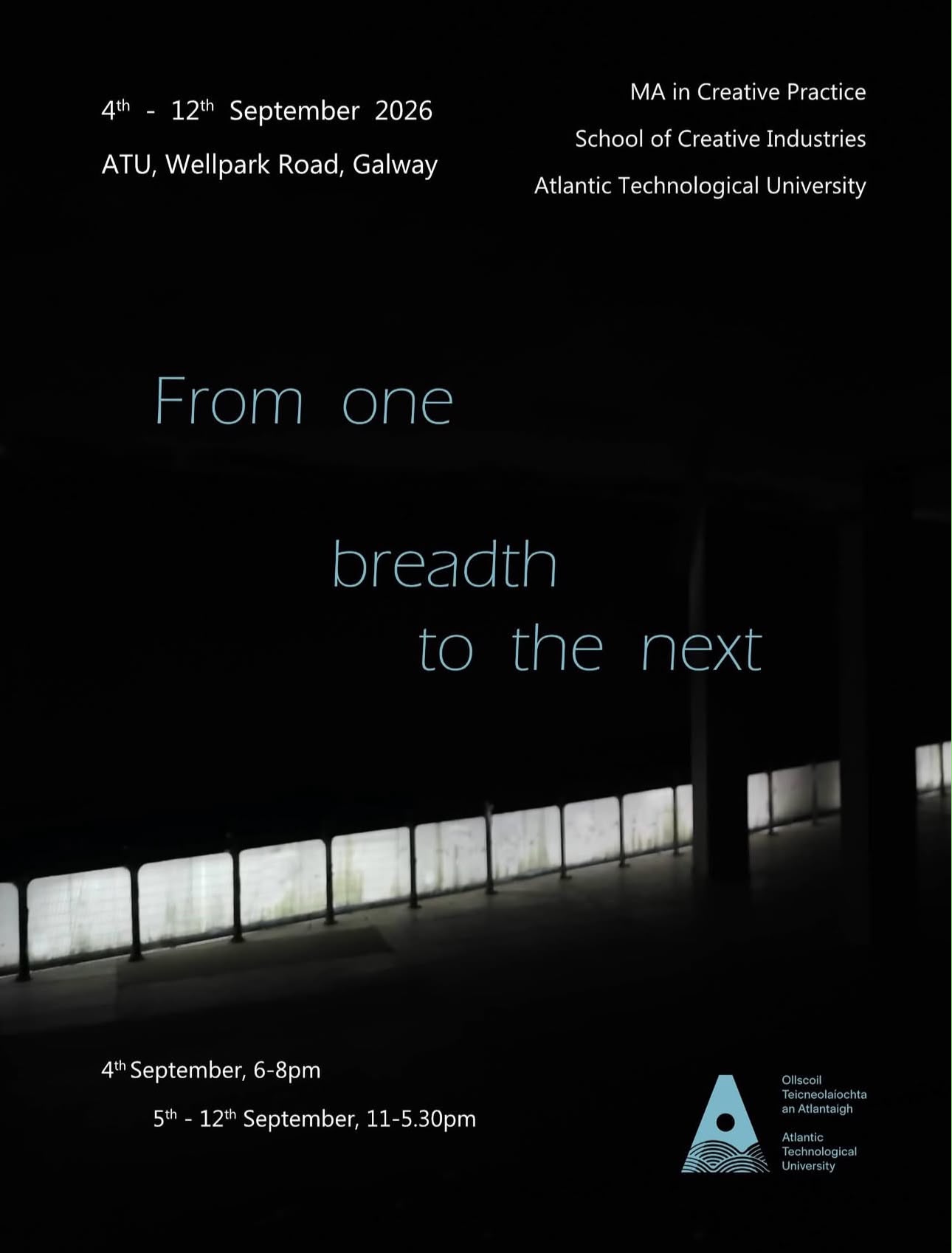
© Bernie Joyce 2026
© Bernie Joyce 2026
Slabhra Síoraí (Eternal Chain)
Irish bogs are among our most intricate ecosystems, where even the smallest organisms exist in delicate balance. These fragile landscapes thrive on subtle exchanges—between organisms, water, air, and soil—and my work translates this ecological logic into sculptures. They reflect the interdependencies of their environment by translating the subtle exchanges among Sundews, Bog Beacons, and Sphagnum moss.
These sculptures are made from natural materials, including bog plants, and are designed to dissolve and decompose over time, re-entering the ecological cycles they reference. Unlike petrochemical plastics, my bio-plastics are alive to their surroundings: they absorb moisture, shift with temperature, and gradually break down. After the exhibition, the sculptures will be documented as they transform—shrinking, growing mould, and dissolving—so that decomposition becomes not an endpoint but an integral part of the artwork’s lifecycle. My ambition is to continue my research and create locally sustained work that raises awareness of fragile ecosystems, such as the bogs of the west of Ireland, without adding to their degradation.
Bog Sculptures
Bog Sculptures
Bog Sculptures
Drúchtín na gCloch (Sundew), 2026, Bernie Joyce, Willow Frame with Myrtle, Bioplastic and Mixed Media, 63.5 cm x 63.5 cm x 88.9 cm

Cnocán Beag (Small Hummock), 2026, Bernie Joyce, Willow Frame with Bog Plants and Bioplastic, 27.94 m x 27.94 cm x 30.48
Connemara’s ochre bogs may appear vast and featureless at first glance, but beneath the hummocks of Purple Moor grass lies a hidden geological history. These raised mounds form through a slow, intricate process: layers of partially decayed plant matter accumulate over time, building the bog’s foundation. Subtle variations in the surface, shaped by water flow, create slightly drier patches—ideal for plants like heather and cotton grass to take root. As these plants grow, they further elevate the surface, setting off a self-reinforcing cycle: the hummock rises, dries, and becomes even more hospitable to new growth. The sculpture Cnocán Beag peels back this living landscape, revealing endless possibilities for life to emerge and thrive.
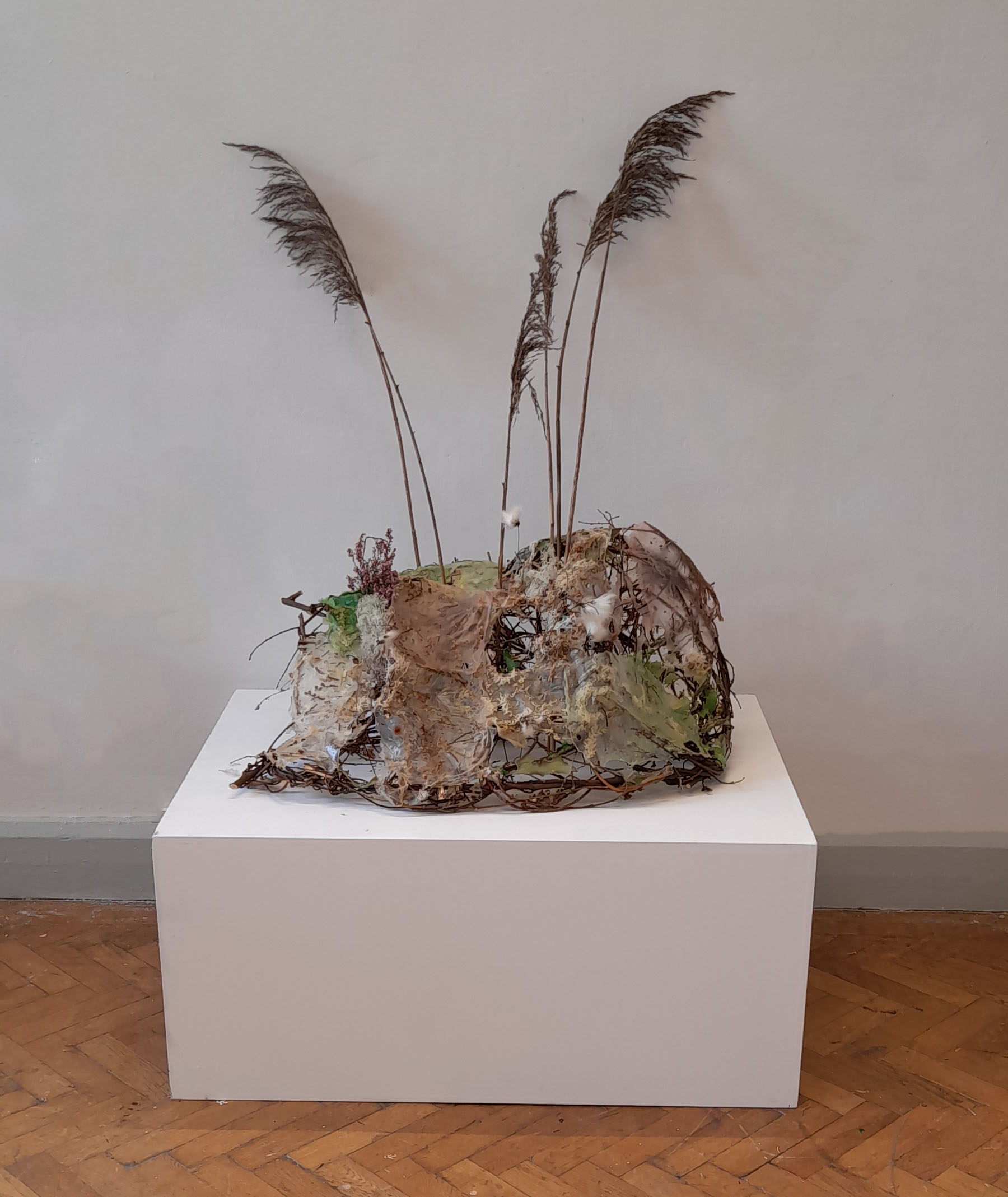
Uisce Beatha (Water of Life), 2026, Bernie Joyce, Willow Frame with Bog Plants and Bioplastic, 110.28 cm x 40.64 cm x 30.48 cm
“Uisce Beatha”—the Irish phrase for "water of life," often used for whiskey—is a poetic name for the lifeblood of Irish bogs. This sculpture reveals the hidden world of microorganisms that thrive in these waterlogged, anaerobic depths, silently breaking down organic matter and shaping the very peat beneath our feet. Through Uisce Beatha, we glimpse a microscopic universe: a vibrant community of life forms uniquely adapted to the bog’s acidic, low-nutrient embrace.

Solas Portaigh (Bog Beacon), 2026, Bernie Joyce, Willow and Myrtle, 139.7 cm x 121.92 cm x 71.12 cm
In a world where the grand and the loud command attention, bogs reveal their magic in the small and the subtle—a hidden realm of intricate detail and quiet wonder. Among these marvels is the Bog Beacon (Mitrula paludosa), with its smooth, golden-orange club-shaped head and slender white stem, standing just 5 cm tall. These unassuming recyclers thrive on decay, flourishing in wetlands across the globe. The sculpture Solas Portaigh spotlights the fungus’s vivid, contrasting colours and its dark, muddy habitat, transforming this miniature world into a sunburst of light and colour—drawing our eyes to the extraordinary beauty often overlooked beneath our feet.
The Turkey Tail fungus (Trametes Versicolor) thrives on dead wood in woodlands and bogs, playing a vital role in nature’s nutrient recycling. Its name comes from the striking, colourful, fan-shaped caps that resemble the tail feathers of a wild turkey. Growing in tiered clusters, this annual mushroom is most visible in autumn and acts as a cornerstone of forest ecology: it exchanges nutrients, aids water absorption, protects plants from disease, and binds soil together—earning its nickname, the "wood-wide web." Historically used to treat gout and skin ailments, it is now being studied for its potential in cancer treatment. Cluas Capall Coille, a fusion of ancient bog oak and bioplastic Turkey Tail, embodies the geocycles that weave the landscape's primordial rhythms into today’s living world. Here, past and present merge, enriching both soil and climate in a seamless, symbiotic dance.
The Turkey Tail fungus (Trametes Versicolor) thrives on dead wood in woodlands and bogs, playing a vital role in nature’s nutrient recycling. Its name comes from the striking, colourful, fan-shaped caps that resemble the tail feathers of a wild turkey. Growing in tiered clusters, this annual mushroom is most visible in autumn and acts as a cornerstone of forest ecology: it exchanges nutrients, aids water absorption, protects plants from disease, and binds soil together—earning its nickname, the "wood-wide web." Historically used to treat gout and skin ailments, it is now being studied for its potential in cancer treatment. Cluas Capall Coille, a fusion of ancient bog oak and bioplastic Turkey Tail, embodies the geocycles that weave the landscape's primordial rhythms into today’s living world. Here, past and present merge, enriching both soil and climate in a seamless, symbiotic dance.
Slabhra Síoraí (Eternal Chain)
Irish bogs are among our most intricate ecosystems, where even the smallest organisms exist in delicate balance. These fragile landscapes thrive on subtle exchanges—between organisms, water, air, and soil—and my work translates this ecological logic into sculptures. They reflect the interdependencies of their environment by translating the subtle exchanges among Sundews, Bog Beacons, and Sphagnum moss.
These sculptures are made from natural materials, including bog plants, and are designed to dissolve and decompose over time, re-entering the ecological cycles they reference. Unlike petrochemical plastics, my bio-plastics are alive to their surroundings: they absorb moisture, shift with temperature, and gradually break down. After the exhibition, the sculptures will be documented as they transform—shrinking, growing mould, and dissolving—so that decomposition becomes not an endpoint but an integral part of the artwork’s lifecycle. My ambition is to continue my research and create locally sustained work that raises awareness of fragile ecosystems, such as the bogs of the west of Ireland, without adding to their degradation.
Connemara’s ochre bogs may appear vast and featureless at first glance, but beneath the hummocks of Purple Moor grass lies a hidden geological history. These raised mounds form through a slow, intricate process: layers of partially decayed plant matter accumulate over time, building the bog’s foundation. Subtle variations in the surface, shaped by water flow, create slightly drier patches—ideal for plants like heather and cotton grass to take root. As these plants grow, they further elevate the surface, setting off a self-reinforcing cycle: the hummock rises, dries, and becomes even more hospitable to new growth. The sculpture Cnocán Beag peels back this living landscape, revealing endless possibilities for life to emerge and thrive.
In a world where the grand and the loud command attention, bogs reveal their magic in the small and the subtle—a hidden realm of intricate detail and quiet wonder. Among these marvels is the Bog Beacon (Mitrula paludosa), with its smooth, golden-orange club-shaped head and slender white stem, standing just 5 cm tall. These unassuming recyclers thrive on decay, flourishing in wetlands across the globe. The sculpture Solas Portaigh spotlights the fungus’s vivid, contrasting colours and its dark, muddy habitat, transforming this miniature world into a sunburst of light and colour—drawing our eyes to the extraordinary beauty often overlooked beneath our feet.
Images will be on view from the 4th of September, opening night of exhibition
Solas Portaigh (Bog Beacon), 2026, Bernie Joyce, Willow and Myrtle, 139.7 cm x 121.92 cm x 71.12 cm
Sphagnum Moss, “Súsán”, the Bog Builder, 2026, Bernie Joyce, White Pen on Black Card, 59.4 cm x 84.1 cm
Sphagnum Moss, “Súsán”, the Bog Builder, 2026, Bernie Joyce, White Pen on Black Card, 59.4 cm x 84.1 cm
Reindeer moss,“Léicean Réinfhia”, 2026, Bernie Joyce, White Pen on Black Card, 59.4 cm x 84.1 cm


Feather Moss, “Cleitchaonach”, 2026, Bernie Joyce, White Pen on Black Card, 59.4 cm x 84.1 cm
Reindeer Moss, “Léicean Réinfhia”, 2026, Bernie Joyce, White Pen on Black Card, 59.4 cm x 84.1 cm

Heather, “Fraoch”, 2026, Bernie Joyce, White Pen on Black Card, 59.4 cm x 84.1 cm
Feather Moss, “Cleitchaonach”, 2026, Bernie Joyce, White Pen on Black Card, 59.4 cm x 84.1 cm
Reindeer Moss, “Léicean Réinfhia”, 2026, Bernie Joyce, White Pen on Black Card, 59.4 cm x 84.1 cm

Reeds, “Giolcach”, 2026, Bernie Joyce, White Pen on Black Card, 59.4 cm x 84.1 cm
Old Man’s Beard (Usnea) is an edible lichen with antiviral, antifungal, and antibacterial properties, effective even against streptococcal and staphylococcal bacteria. Like Sphagnum moss, it was historically used in bandages. As noted by JJ Pursell, Usnea selectively targets harmful bacteria while preserving beneficial gut flora, and can be applied externally for staph infections and cellulitis. Traditionally, it was most valued for treating respiratory issues, earning it the nickname “lungs of the forest.” It grows slowly on trees and decaying wood, only in areas with clean air across Europe, Asia, and the US. Usnea is light green, attaches to wood at a single point, and forms round bunches with a white inner core.
Bog Myrtle (Myrica gale) flowers in catkins (April–May) on separate male and female plants. Traditionally, it was used medicinally for skin, digestion, and colds, as a flavouring in beers and dishes, and for yellow dye, leather tanning, and candle making. Culturally, bog myrtle held symbolic significance in the language of flowers, often included in bridal bouquets to represent love, purity, and long life.
Bog Myrtle (Myrica gale) flowers in catkins (April–May) on separate male and female plants. Traditionally, it was used medicinally for skin, digestion, and colds, as a flavouring in beers and dishes, and for yellow dye, leather tanning, and candle making. Culturally, bog myrtle held symbolic significance in the language of flowers, often included in bridal bouquets to represent love, purity, and long life.
Heather (Calluna vulgaris) is a familiar native shrub of Ireland’s acidic bogs, mountains and moorlands. In late summer, its purple blooms paint the bogland in shades of mauve, while the occasional white-flowered plant is traditionally regarded as a sign of good luck. Heather has long been valued for its practical uses, including making floor brushes, dyeing wool and adding flavour to honey.
The Common Reed (Phragmites australis) can grow up to 19 feet tall in freshwater habitats, where its dense stands provide valuable shelter and nesting habitat for a wide range of birds and other wildlife. It is easily recognised by its tall golden stems and large, feathery flower heads, which emerge with a purplish hue before fading to brown. For centuries, common reed was an important building material in Ireland, traditionally used as thatch for roofs and walls well into modern times.
Heather, “Fraoch”, 2026, Bernie Joyce, White Pen on Black Card, 59.4 cm x 84.1 cm
Reeds, “Giolcach”, 2026, Bernie Joyce, White Pen on Black Card, 59.4 cm x 84.1 cm
Heather, “Fraoch”, 2026, Bernie Joyce, White Pen on Black Card, 59.4 cm x 84.1 cm
Reeds, “Giolcach”, 2026, Bernie Joyce, White Pen on Black Card, 59.4 cm x 84.1 cm
Geata Draíochta (Portal), 2026, Bernie Joyce, Willow with Reindeer Moss and Bioplastic,
88.9 cm × 81.28 cm
Bogbean (Menyanthes Trifoliata) blooms from March to June, its starry white and pink flowers adorned with a delicate hair fringe. The plant thrives in shallow waters, and its name comes from the resemblance of its leaves to broad beans. In some parts of Northern England, it was once called ‘Bog Hop’—locals used it as a substitute for hops to flavour beer. The wall sculpture Geata Draíochta acts as a portal into the bog’s hidden world. Stepping through this gateway invites you on a journey of discovery, revealing the intricate details of the living landscape that are often overlooked.
Sphagnum Moss, “Súsán”, the Bog Builder, 2026, Bernie Joyce, White Pen on Black Card, 59.4 cm x 84.1 cm
Sphagnum moss, the "bog builder," grows densely in raised bogs, retaining up to twenty times its weight in water. Historically, its absorbent and antiseptic qualities made it ideal for wartime bandages—earning it the Irish name Súsán. The plant features two branch types: spreading branches for structure, and hanging branches to absorb water. A single bog pool with the moss can host over 32,000 microscopic organisms. It reproduces via spores, launched from capsules that burst open to spread and grow into new moss.
Feather Moss, “Cleitchaonach”, 2026, Bernie Joyce, White Pen on Black Card, 59.4 cm x 84.1 cm
Reindeer Moss, “Léicean Réinfhia”, 2026, Bernie Joyce, White Pen on Black Card, 59.4 cm x 84.1 cm
Feather Moss (Eurhynchium striatum) is a type of moss—rootless, evergreen, and flowerless. Like all mosses, it reproduces not by seeds, but by spores. True to its name, it forms feathery cushions or mats that can spread across large areas, thriving on stones and forest floors in the cool, shaded environments of Europe and Russia.
Reindeer Moss, (Cladonia rangiferina)—despite its name—is actually a lichen, not a moss. Highly tolerant of cold and drought, it can survive extreme dehydration, shifting from soft and spongy to brittle. This hardy organism is a symbiotic partnership between a fungus and an alga. True to its name, it serves as a vital food source for reindeer.
Old Man’s Beard, “Caonach Clúmhach”, the “Lungs of the Forest”, 2026, Bernie Joyce, Pen on Black Card, 59.4 cm x 84.1 cm
Bog Myrtle, "Raideog", 2026, Bernie Joyce, White Pen on Black Card, 59.4 cm x 84.1 cm
Old Man’s Beard (Usnea) is an edible lichen with antiviral, antifungal, and antibacterial properties, effective even against streptococcal and staphylococcal bacteria. Like Sphagnum moss, it was historically used in bandages. As noted by JJ Pursell, Usnea selectively targets harmful bacteria while preserving beneficial gut flora, and can be applied externally for staph infections and cellulitis. Traditionally, it was most valued for treating respiratory issues, earning it the nickname “lungs of the forest.” It grows slowly on trees and decaying wood, only in areas with clean air across Europe, Asia, and the US. Usnea is light green, attaches to wood at a single point, and forms round bunches with a white inner core.
Bog Myrtle (Myrica gale) flowers in catkins (April–May) on separate male and female plants. Traditionally, it was used medicinally for skin, digestion, and colds, as a flavouring in beers and dishes, and for yellow dye, leather tanning, and candle making. Culturally, bog myrtle held symbolic significance in the language of flowers, often included in bridal bouquets to represent love, purity, and long life.
Bog Myrtle (Myrica gale) flowers in catkins (April–May) on separate male and female plants. Traditionally, it was used medicinally for skin, digestion, and colds, as a flavouring in beers and dishes, and for yellow dye, leather tanning, and candle making. Culturally, bog myrtle held symbolic significance in the language of flowers, often included in bridal bouquets to represent love, purity, and long life.
Heather, “Fraoch”, 2026, Bernie Joyce, White Pen on Black Card, 59.4 cm x 84.1 cm
Feather Moss, “Cleitchaonach”, 2026, Bernie Joyce, White Pen on Black Card, 59.4 cm x 84.1 cm
Reindeer Moss, “Léicean Réinfhia”, 2026, Bernie Joyce, White Pen on Black Card, 59.4 cm x 84.1 cm
Reeds, “Giolcach”, 2026, Bernie Joyce, White Pen on Black Card, 59.4 cm x 84.1 cm
Heather (Calluna vulgaris) is a familiar native shrub of Ireland’s acidic bogs, mountains and moorlands. In late summer, its purple blooms paint the bogland in shades of mauve, while the occasional white-flowered plant is traditionally regarded as a sign of good luck. Heather has long been valued for its practical uses, including making floor brushes, dyeing wool and adding flavour to honey.
The Common Reed (Phragmites australis) can grow up to 19 feet tall in freshwater habitats, where its dense stands provide valuable shelter and nesting habitat for a wide range of birds and other wildlife. It is easily recognised by its tall golden stems and large, feathery flower heads, which emerge with a purplish hue before fading to brown. For centuries, common reed was an important building material in Ireland, traditionally used as thatch for roofs and walls well into modern times.